

Flexible Access Point
Transparent Clock (TC)Boundary Clock (BC)
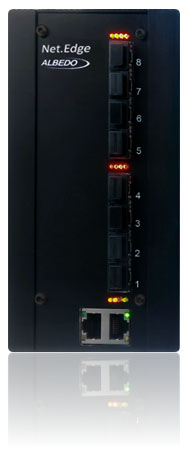
Net.Edge
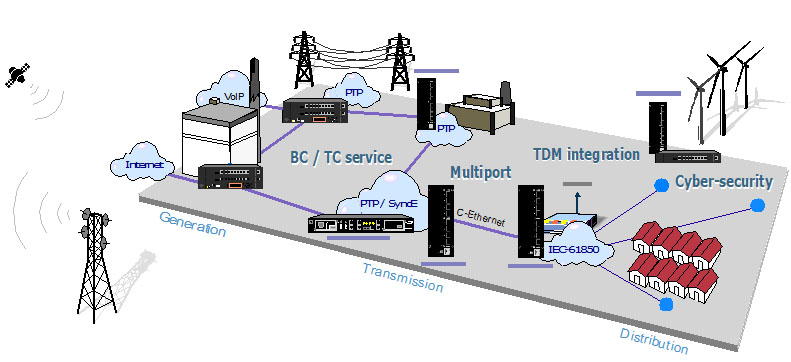
Net.Edge makes Net.Time services available across the WAN and substations. You can set it up as either a boundary clock (BC) or a transparent clock (TC), and it can carry PTP to the edges. It also filters and regenerates the signal before sending it through its ports. This approach has been shown to shorten paths, improve quality and make it easier to expand across the entire utility network.
PTP ports at the edge
If you bring the time closer to the client, the last hop won't be affected by long and variable WAN paths. This makes sure that delays and recoveries are always the same when traffic or routes change, which stops false alarms and makes sure that what happens is correct. It is important to keep Net.Time GM in specific places and use Net.Edge to share time in the area, so that everything works in the same way.
PTP ports at the edge
Net.Edge improves Net.Time's abilities by allowing PTP to be sent across the WAN, delivering it through any of its eight ports, and adapting bit rates (up to 2.5 GbE) with a 11 Gbps switch matrix. In short, Net.Edge makes sure that time is sent across MPLS/Carrier Ethernet and is restored at the substation.
Modernize tele-protection
Keep the relays and move C37.94 / E1 / serial channels onto packet networks without touching the protection devices. Net.Edge supports switching over without any downtime and monitoring/adjusting asymmetries to protect distance and differential schemes.
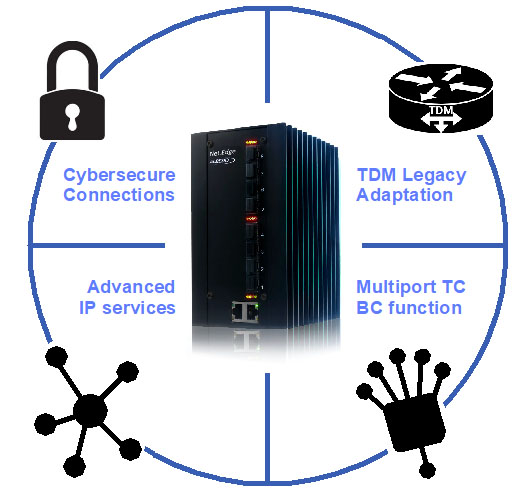
This makes it easier to move TDM applications without having to change the wiring. You can keep using the same 2 Mb/s multiplexers and older interfaces while adding IP services directly to Net.Edge. Timing and cyber security policies are in place for all services.
SCADA, cameras, OT traffic
Aggregate SCADA, RTUs and IP cameras alongside timing. Class-of-service and private circuits (point-to-point or multi-point) keep traffic predictable while timing remains unaffected. Optional AES-256 encryption and authentication for transported services; local keying or automated exchange available.
Cybersecure
You can choose to use optional AES-256 encryption and authentication for transported services. Use local keying or automated exchange.
Utility grade build
It is small, quiet and works well even in hard-to-reach places. The device can handle changes to power or WAN routes because it has two DC inputs and strong connections.
The Net.Edge is designed for use in substation environments (IEC 61850-3 / IEEE 1613). It can operate continuously at temperatures between -20 °C and +65 °C, has an IP40 rating, and does not require a fan.